
Deep-ultraviolet (DUV, λ < 200 nm) all-solid-state lasers, essential to modern scientific research and industrial manufacturing, are widely applied in fields from material analysis to lithography. Their commercialization depends heavily on high-performance nonlinear optical (NLO) crystals, but developing such crystals is hampered by strict requirements: they must simultaneously possess large second harmonic generation (SHG) responses, moderate birefringence, and wide bandgaps.
Borates have long been a research focus for their exceptional DUV transmission properties. Though materials like β-BBO and LBO have been developed, most cannot achieve DUV phase matching via direct frequency doubling. Fluoroborate systems have emerged as leading candidates due to structural diversity and superior performance, yet existing ones such as KBBF suffer from layered growth habits and toxic raw materials. Moreover, DUV NLO crystals with chain-like polymerized [BO3]3- units are scarce. Thus, designing structural strategies to realize ordered arrangement of functional units has become key to breaking the performance bottlenecks of DUV NLO materials.
To tackle these challenges, a research team from the Xinjiang Technical Institute of Physics and Chemistry (XTIPC) of the Chinese Academy of Sciences, has proposed a novel structural design strategy based on the synergistic assembly of fluorinated polyhedra and planar B–O groups. By harnessing the "shearing" effect and directional polymerization capability of fluorinated polyhedra, the team realized the uniform alignment of π-conjugated functional units, leading to the successful synthesis of a series of alkali metal fluoroborates, namely KABF, RABF, and CABF.
The key feature of this work lies in the use of fluorinated polyhedra to modulate the orientation of planar B–O units, thereby constructing novel crystal structures featuring 1∞[BO2] chains. Within these structures, [BO3F]4- tetrahedra and chain-like polymerized [BO3]3- units undergo synergistic assembly, forming parallel-aligned 2∞[B4O6F] layered architectures.
The resulting materials demonstrate several performance metrics: their SHG responses reach 1.6–1.7 times that of KDP (at 1064 nm) and 0.4–0.5 times that of BBO (at 532 nm). They also achieve a shortest Type I phase-matching wavelength as low as 161.5–168.6 nm, with UV cutoff edges falling below 190 nm. This strategy overcomes challenges in controlling the construction of chain-like polymerized [BO3]3- units and the assembly of non-centrosymmetric structures.
Furthermore, through cation-mediated structural adaptation, it further validates the stability and diversity of the fluoroborate material system.
Beyond delivering candidates for DUV NLO crystals, this work establishes a design paradigm for the synergistic interaction between fluorinated polyhedra and polymerized [BO3]3- units, paving a new path for the development of beryllium-free, low-toxicity DUV NLO materials.
The research findings were recently published in Advanced Functional Materials. This work was supported by funding from the National Key Research and Development Program of China, the National Natural Science Foundation of China, and other sources.
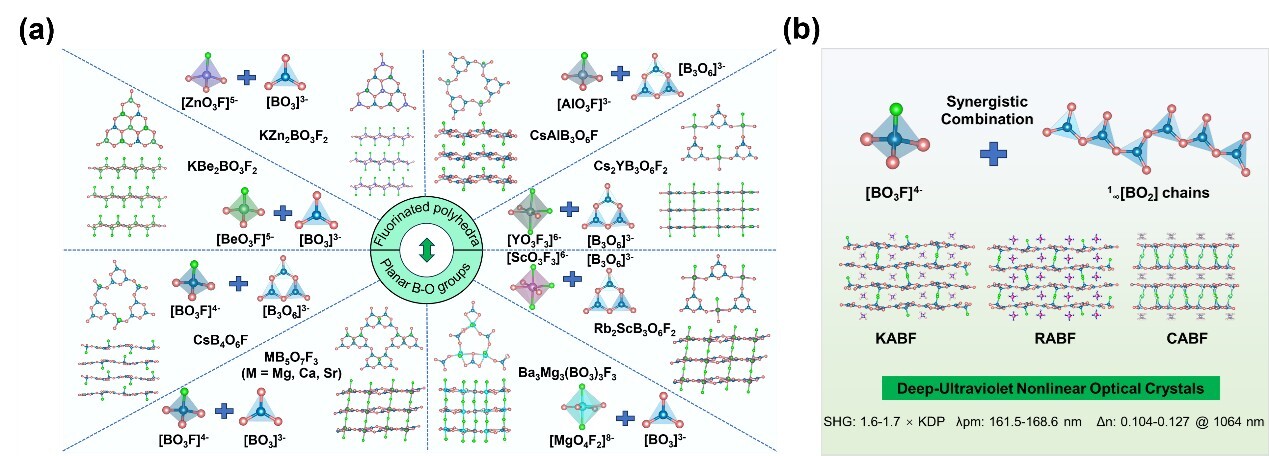
Fig. (a) Representative structures of the synergistic combination of fluorinated polyhedra and π-conjugated B–O groups; (b) DUV NLO crystals designed and synthesized in this work. (Image by XTIPC)

86-10-68597521 (day)
86-10-68597289 (night)

52 Sanlihe Rd., Xicheng District,
Beijing, China (100864)
Copyright © 2002 - Chinese Academy of Sciences


